Dead Hang Benefits: What the Evidence Supports and What It Does Not
Dead hang benefits, examined honestly: what the grip-strength research actually shows, why the shoulder claim does not hold up, and how to start properly.
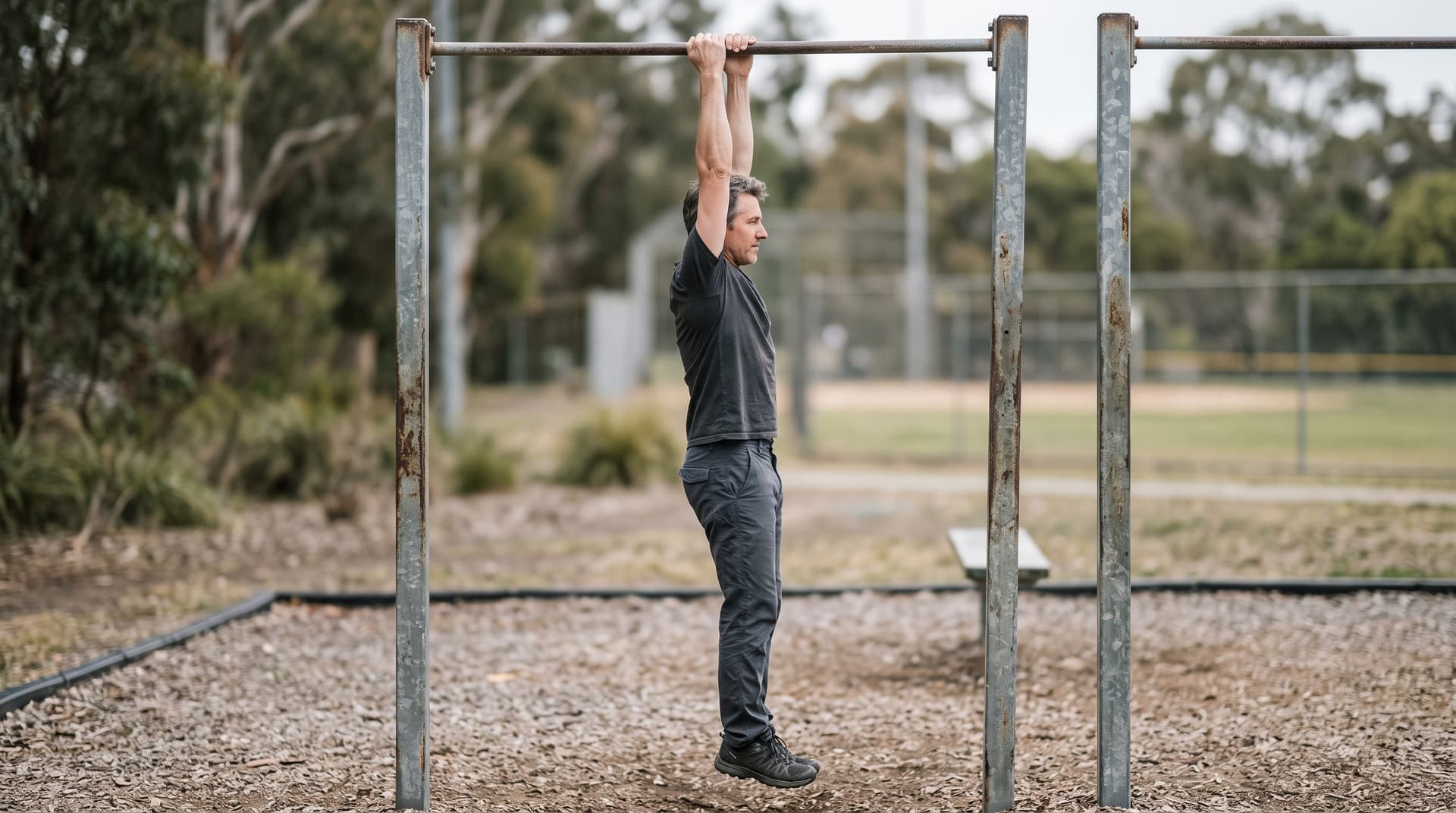
Dead hang benefits are the rare fitness claim that sounds too good to be true and is partly backed by one of the largest studies ever run on physical capacity. Hang from a bar, the argument goes, and you build grip strength — and grip strength predicts how long you live.
That first part is real, and the study behind it is enormous. What happens next is where it falls apart: the longevity finding gets welded to a shoulder claim that was never tested properly, and both get wrapped in benchmark charts that nobody can source.
This article separates the three. You will get a starting protocol at the end, because hanging is cheap, safe for most people and worth doing. But you will also get an honest account of what it does and does not do, which is more than the pages currently ranking for this will give you.
What a dead hang actually is
Grab a bar with both hands, arms straight overhead, and let your body weight hang. Shoulders stay engaged rather than completely slack. That is the whole movement.
It demands grip endurance, shoulder stability and a surprising amount of trunk control. It needs nothing but a bar, which is most of its appeal — and most of the reason the list of claimed dead hang benefits has grown well past what anyone has tested.
The longevity claim: what the research actually measured
This one is substantially true, and the scale of the evidence is genuinely impressive.
The [Prospective Urban Rural Epidemiology study, published in The Lancet], followed 139,691 adults across 17 countries for a median of four years. For every 5 kg reduction in grip strength, researchers recorded a 16% higher risk of death from any cause, a 17% higher risk of cardiovascular death, a 7% higher risk of heart attack and a 9% higher risk of stroke.
Those are large numbers from a very large sample, and they hold across wildly different countries and income levels. Grip strength really is a remarkable predictor — in the same family as VO2 max as a marker of how long you live.
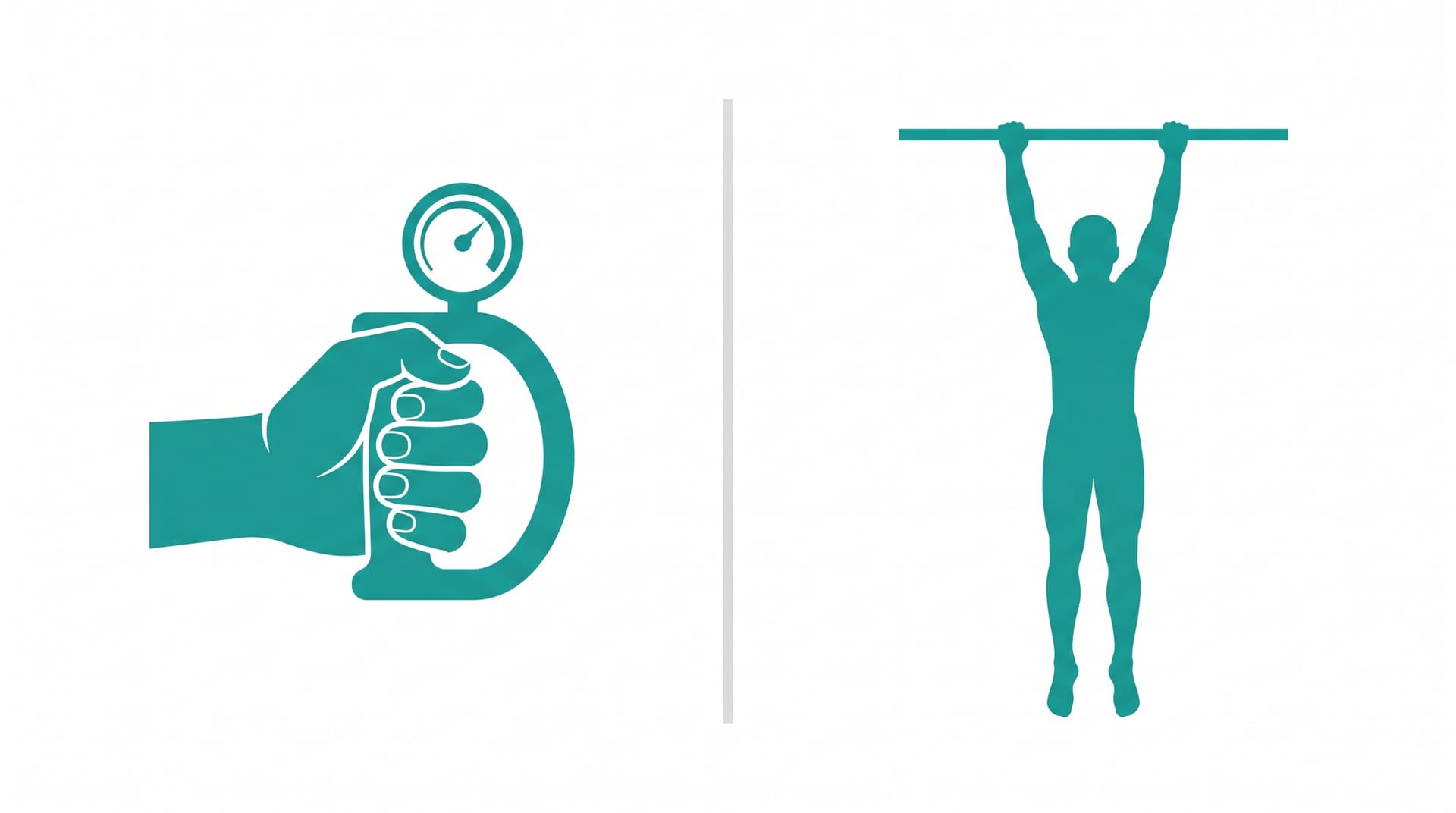
But read what the researchers said about what it means. The Lancet's own announcement states plainly that the study shows grip strength predicts these outcomes, and that it does not show that training your grip improves them. Further research, it says, is needed to establish whether improving muscle strength reduces risk.
That distinction is the entire ballgame, and almost every article you will read about dead hangs and longevity skips it.
Why a predictor is not a lever
Grip strength works as a predictor because it is a cheap proxy for something much broader: total muscle mass, nutritional status, neurological function, and whatever else is quietly going right or wrong in a body. A weak grip at 60 is usually a symptom, not a cause.
The useful analogy is a thermometer. A high reading predicts a bad outcome very reliably. Cooling the thermometer does not treat the infection.
Whether deliberately training grip strength shifts those mortality curves is an open question the PURE study did not ask and cannot answer. It might. Nobody has shown it.
Hang time is not grip strength
There is a second gap, and it is more specific.
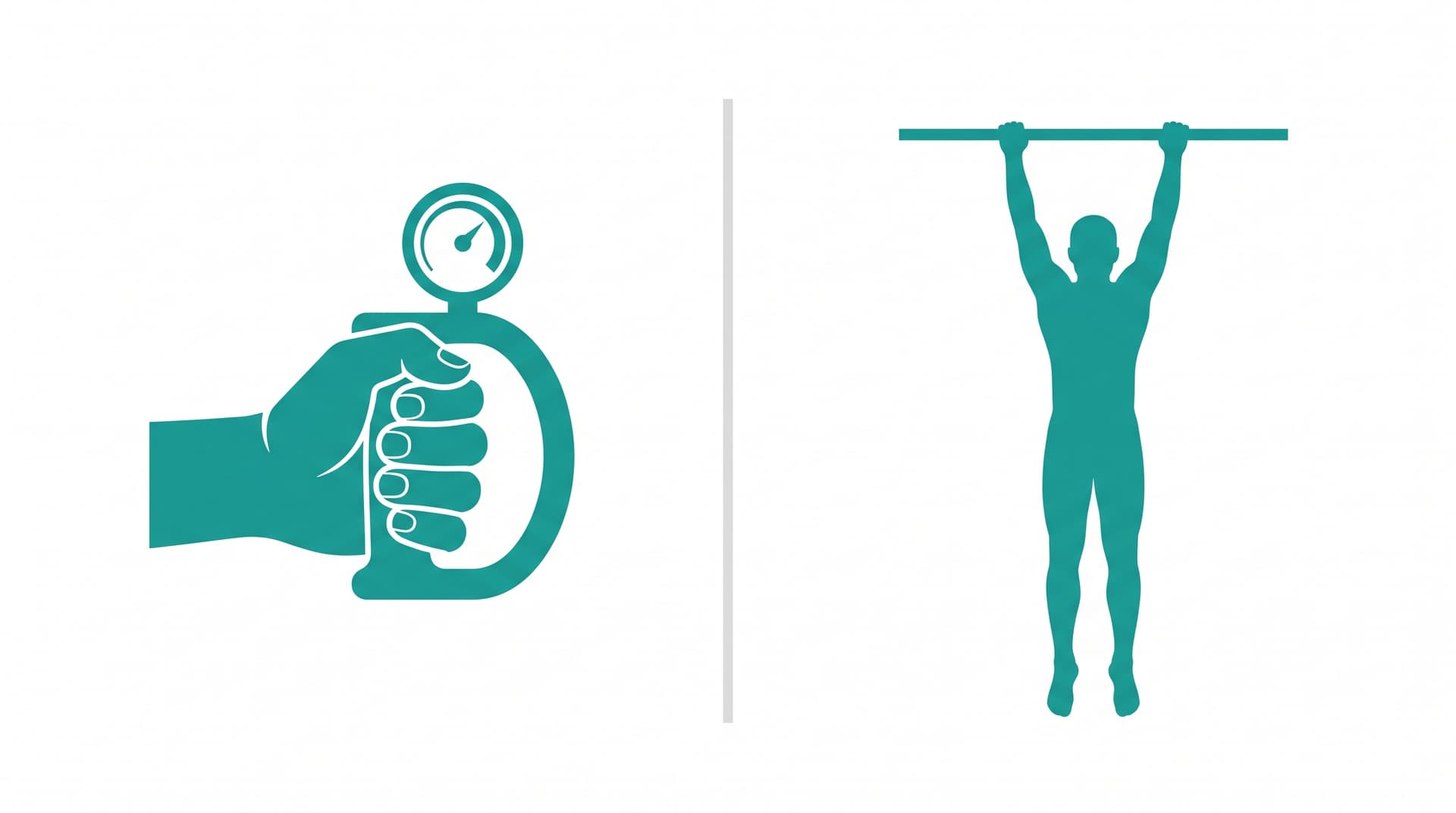
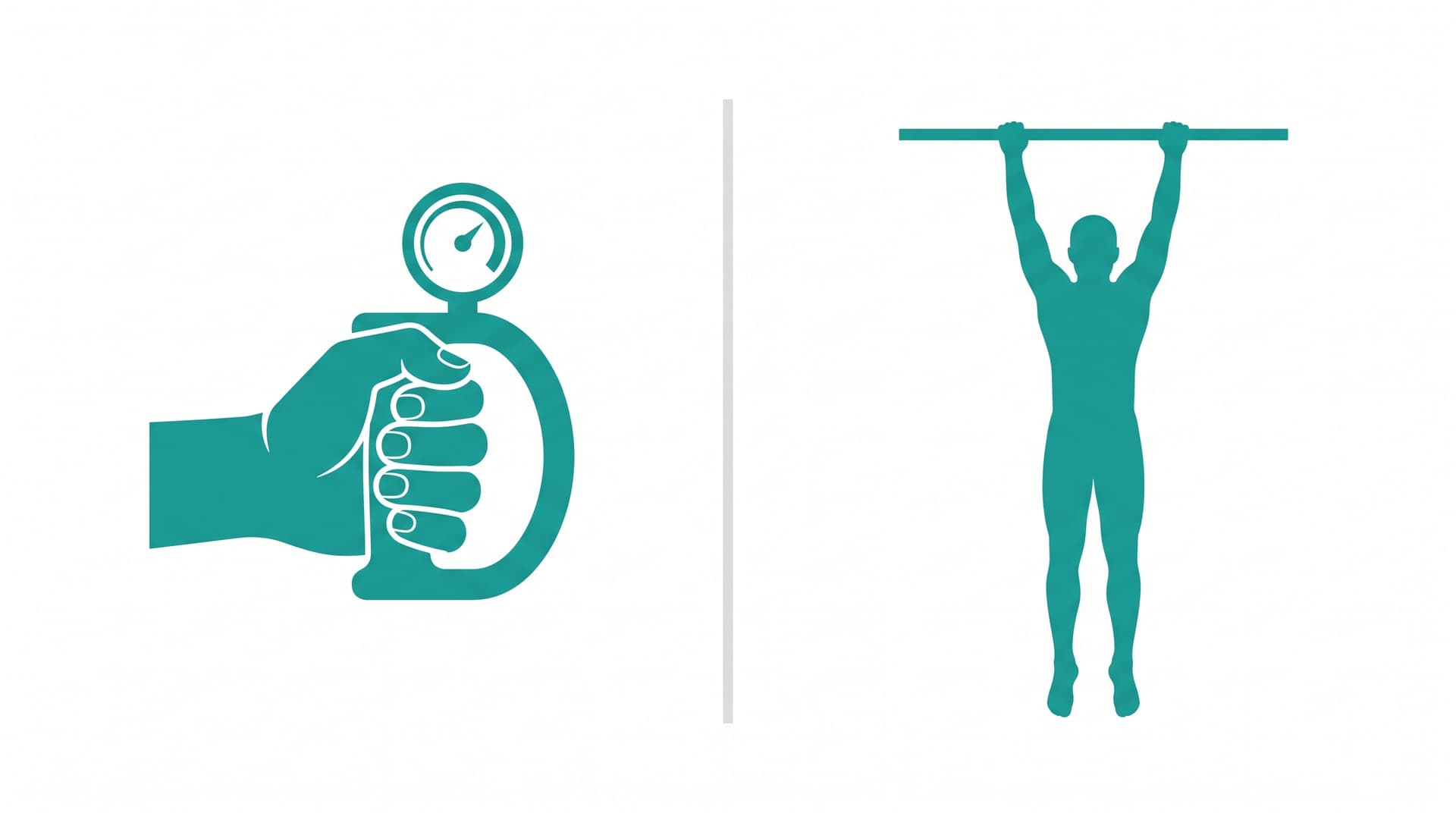
PURE measured grip strength with a handgrip dynamometer — a device you squeeze once, as hard as you can, which records peak force in kilograms. That is a maximal strength measurement lasting a couple of seconds.
A dead hang measures something different: how long you can sustain a submaximal grip while supporting your body weight. It is an endurance test, and it is confounded by how much you weigh. A heavier person with a stronger grip can easily hang for less time than a lighter person with a weaker one.
So when an article tells you that hanging for 60 seconds puts you in a healthy mortality bracket, it has quietly swapped one measurement for another. The research is about dynamometer readings. The advice is about hang time. They are not interchangeable.
The shoulder claim, and where it came from
The other thing you will hear is that hanging cures shoulder pain — often attached to a striking figure, something close to 99% of cases.
That claim traces back to a single orthopaedic surgeon's case series of his own patients. It was published in a self-published book, not in a peer-reviewed journal. There was no control group and no randomisation, and the surgeon was both the treating physician and the person assessing whether treatment worked. No independent group has replicated it.
That does not make it false. Clinicians notice real things long before trials confirm them, and a case series is how a lot of medicine starts. But it is a hypothesis, not a finding, and it has been circulating for years as though it were the latter.
What a surgical trial tells us about "decompression"
The mechanism usually offered is that hanging opens up the subacromial space — the gap beneath the bony arch of the shoulder where tendons can become compressed.
There is a direct test of that idea, and it is not encouraging.
The [CSAW trial, published in The Lancet], randomised 313 patients with persistent subacromial shoulder pain across 32 UK hospitals and 51 surgeons into three groups: arthroscopic decompression surgery, placebo surgery where surgeons performed an arthroscopy without the decompression, and no surgery at all.
At six months and at one year, decompression surgery offered no greater benefit than the placebo operation. Compared with no surgery, the surgical group improved slightly more — but, in the trial's own words, that difference was not believed to be clinically significant.
Surgically enlarging the subacromial space did not beat a sham procedure. If the most direct possible intervention on that space produces no benefit over placebo, the claim that hanging from a bar achieves something meaningful through the same mechanism needs more evidence than it currently has.
The trial's authors do note that some subgroup of patients may still benefit and that further research is needed. That caveat is real, and it cuts both ways.
The benchmark charts nobody can source
Search for how long you should be able to hang and you will find confident tables: times by age, by sex, by training level.
Follow the citations and they evaporate. One widely shared article promises age-based standards in its title and never provides them in its body. Its fitness-level ranges — beginner, intermediate, advanced — carry no attribution at all. A claim about how fast untrained adults improve is supported by a citation to a paper about mountain bike racing.
The grip-and-mortality studies it does cite are real, but they are about dynamometer readings, not hang time. The numbers have been borrowed from one measurement and applied to another.
I am not going to reproduce a table of hang times by age, because I cannot find a primary source for one. If you see such a chart, check whether it names a study. In my search, none did.
Dead hang benefits that do hold up
Strip away the overreach and something worthwhile remains.
It trains grip endurance directly. Hanging under load is a specific, measurable capacity, and it improves with practice. Whether that shifts your mortality risk is unknown; that it makes you better at carrying, climbing and holding on is not in doubt.
It loads the shoulder through full overhead extension. Most adults spend almost no time with their arms fully overhead bearing weight. Doing so regularly maintains a range of motion that otherwise quietly disappears.
It costs nothing and takes a minute. Any bar works. There is no equipment to buy, no technique to learn, and no programming to get wrong — which matters more than it sounds, because the exercise you actually do beats the optimal one you skip.
It is a self-assessment you can repeat. Your hang time today versus in six weeks is a real signal about your own trajectory, even though it tells you nothing about where you sit against a population norm.
Those are the dead hang benefits that survive scrutiny, and they describe a good exercise. It is simply not a longevity intervention or a shoulder treatment, and it does not need to be either one to earn a place in your week.
How to start
Week 1 — find your baseline
Hang from a bar with both hands, arms straight, feet off the floor. Time it once. Stop when your grip genuinely fails, not when it starts to burn. Write the number down. That number is yours and is not meant to be compared to anyone else's.
Weeks 2 to 4 — accumulate, do not max out
Three to four short hangs, three days a week, each one ending a few seconds before failure. Total time under the bar matters more than any single heroic effort.
If you cannot hang at all yet
Keep your feet on the floor or on a box and take as much weight through your arms as you can manage. That is a real training stimulus, and it is where most people should start.
Beyond that
Add time before you add anything else. Single-arm variations, weighted hangs and active hangs all exist, and none of them are necessary.
Who should be cautious
Talk to a clinician before you start if you have existing shoulder pain or a diagnosed shoulder problem, a history of dislocation or instability, uncontrolled high blood pressure, or recent injury or surgery to the shoulder, elbow or wrist.
That first one deserves emphasis. The popular claim is that hanging fixes shoulder pain, so people with painful shoulders are precisely the group most likely to try it. Given that the claim rests on an unreplicated case series, and given what the CSAW trial found about the mechanism behind it, a painful shoulder is a reason to get assessed rather than a reason to start hanging from a bar.
Grip strength does not exist in isolation either — if your goal is the broader capacity that PURE was really measuring, progressive strength training does more for total muscle mass than any single exercise, and rucking adds load to something you already do.
✅ Key Takeaway
Hang because it is free, quick and keeps your shoulders moving through a range you otherwise lose. Track your own time against your own time. Do not expect it to extend your life, and do not use it to treat a painful shoulder — grip strength predicts mortality rather than causing it, and the one direct test of the "decompression" mechanism failed against placebo.
Frequently Asked Questions
Is a 1-minute dead hang good?
It is a respectable time for most adults, but "good" has no sourced definition. The benchmark charts circulating online do not cite primary data, and hang time is confounded by body weight — a heavier person with a stronger grip may hang for less time than a lighter person with a weaker one. The more useful comparison is your own time now against your own time six weeks from now.
Are dead hangs actually good for you?
Yes, modestly and for ordinary reasons. They train grip endurance, they load the shoulder through full overhead extension — a range most adults never use — and they cost nothing. What they have not been shown to do is extend life or treat shoulder pain, which are the two claims most often made for them.
Do dead hangs increase lifespan?
No study has shown that. The confusion comes from the PURE study, which followed 139,691 adults across 17 countries and found that each 5 kg reduction in grip strength was associated with a 16% higher risk of death from any cause. But The Lancet's own announcement states the study shows grip strength predicts these outcomes and does not show that training grip improves them. Grip is likely a proxy for overall muscle mass and health rather than a cause.
Do dead hangs fix shoulder pain?
The claim that hanging resolves most shoulder pain comes from one surgeon's case series of his own patients, published in a self-published book rather than a peer-reviewed journal, with no control group and no independent replication. Separately, the CSAW trial randomised 313 patients and found that surgically decompressing the subacromial space was no better than placebo surgery. If you have shoulder pain, get it assessed rather than treating it with a bar.
How long should a beginner hold a dead hang?
Long enough to find an honest baseline, then build from there. For many beginners that is 10 to 20 seconds, and for some it means keeping the feet on a box and taking partial weight through the arms. Accumulating three or four short hangs several times a week produces more progress than one maximal effort.
⚕️ Medical Disclaimer
This article is for informational purposes only and does not constitute medical advice. Speak to a qualified healthcare provider before starting hanging exercises if you have shoulder pain, a history of shoulder instability, uncontrolled high blood pressure, or any recent injury or surgery to the upper limb.
References
- Leong DP, et al. Prognostic value of grip strength: findings from the Prospective Urban Rural Epidemiology (PURE) study. The Lancet, 2015 — summarised in The Lancet's press release
- Beard DJ, et al. Arthroscopic subacromial decompression for subacromial shoulder pain (CSAW): a multicentre, pragmatic, parallel group, placebo-controlled, three-group, randomised surgical trial. The Lancet, 2018 — trial summary from the University of Oxford NDORMS
Rate this article
Click on a star to rate this article
Keep Reading
VO2 Max: The Best Single Predictor of How Long You Live
VO2 max is a stronger mortality predictor than smoking or diabetes. What good vs poor looks like by age, the 4x4 protocol that raises it fastest, and why HIIT
Read article →
fitness10000 Steps a Day: Where the Number Actually Came From
10000 steps a day started as a 1965 Japanese marketing slogan, not research. What the actual evidence says about step counts, all-cause mortality, and the real
Read article →
fitnessWalking After Meals: What the Research Shows
Walking after meals explained: what trials found for blood sugar, how soon and how long to walk, who benefits, and what the studies cannot yet show.
Read article →

Vitality & Strength Editorial Team
Independent research synthesists — not licensed clinicians
Independent health writers and research synthesists. We are not doctors or registered dietitians; every claim we publish is sourced and linked to primary research, and we take no affiliate or industry money.