Caffeine Half-Life: The 3pm Coffee Math Most People Miss
Caffeine half-life runs 5-6 hours. A 3pm coffee still has 25% of peak at 3am. The math behind the anxiety + sleep cost most adults underestimate.

The caffeine half-life is the single number that explains why so many adults sleep badly and feel wired at the wrong times. It runs about 5 to 6 hours in healthy adults. That means a 3 PM coffee still leaves roughly a quarter of the peak dose circulating in your blood at 3 AM, which is when your body is supposed to be in deep sleep. Most people drink afternoon coffee assuming the alertness wears off by dinner. The pharmacology says otherwise. The cost shows up as harder time falling asleep, fragmented deep sleep, and a baseline jitter that gets blamed on stress when it is actually just yesterday's coffee that hasn't fully cleared yet. This article walks through the half-life math, why genetics make the same dose hit people very differently, the cutoff time that actually protects sleep, and how to taper without the rebound headache that drives most people back to a five-cup day.
⚕️ Medical Disclaimer
This article is for informational purposes only. Consult a qualified healthcare provider before changing any supplement, training, or dietary routine.What caffeine actually does in your nervous system
Caffeine works by blocking adenosine receptors. Adenosine is a sleep-promoting molecule that builds up in your brain the longer you are awake. The more it accumulates, the sleepier you feel. When caffeine occupies those receptors, the adenosine signal can't dock and your brain stays alert. [The Sleep Foundation's review] notes this blockade is also why caffeine consumption can disrupt sleep architecture — the adenosine that built up while you were awake doesn't get to do its job at bedtime.
What this means in practice: caffeine doesn't add energy. It hides tiredness. The fatigue is still there underneath. As soon as caffeine clears, the signal you were ignoring comes back, often stronger than before because more adenosine has accumulated in the meantime. That post-coffee crash isn't your imagination. If the jitters and the crash are the part you want to avoid, pairing caffeine with L-theanine is the most evidence-backed way to blunt both.
The other relevant pharmacology is the cardiovascular and adrenal piece. Caffeine increases circulating epinephrine and norepinephrine, raises resting heart rate slightly, and elevates cortisol in the hours after intake. Those changes are useful for performance and exercise. They are less useful when you are trying to wind down at 7 PM and your body is still running on a 4 PM cup of coffee.
The caffeine half-life: 5 to 6 hours and why that matters
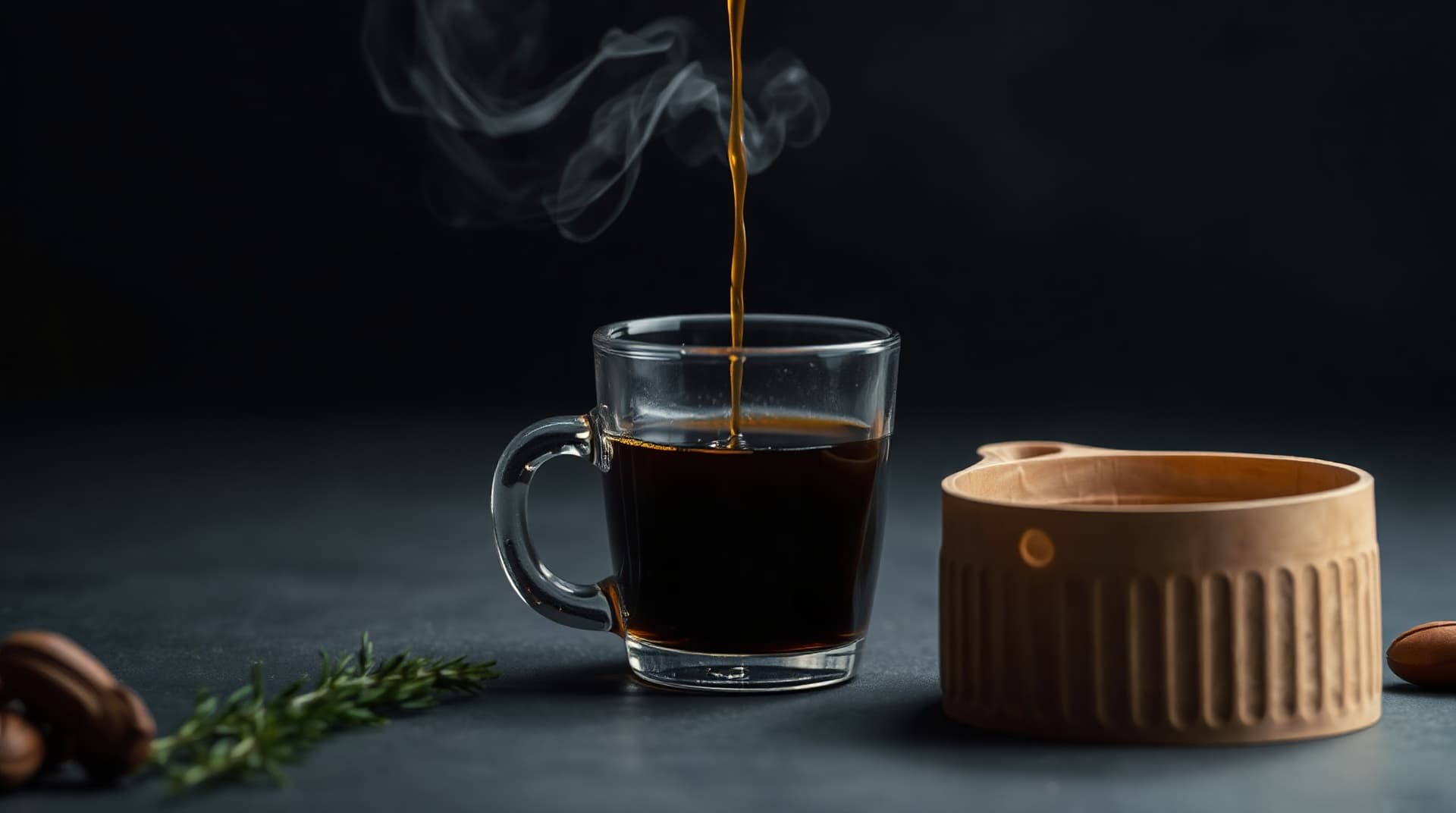
The half-life is the time it takes for half of a substance to clear your bloodstream. For caffeine in healthy adults, that number sits between 5 and 6 hours. After one half-life, you have 50% of peak. After two half-lives, 25%. After three, around 12%.
The 3 PM to 3 AM math
Walk that out for a 3 PM coffee. By 9 PM, half the caffeine is still in you. By 3 AM, a full quarter of peak is still active. A quarter of a 100 mg cup is 25 mg. That's not trivial — 25 mg is about a third of a typical espresso shot, blocking your adenosine receptors during the deep-sleep window your brain needs most.
Why this surprises people
You don't feel caffeine at 3 AM the way you feel it at 3:15 PM. The subjective alertness fades within a few hours because your dopamine response habituates. But the receptor-level blockade keeps going. [A 2013 randomized trial in the Journal of Clinical Sleep Medicine] compared 400 mg of caffeine taken at 0, 3, or 6 hours before bedtime against placebo. All three timings produced measurable sleep disruption. Even the 6-hour-before-bed dose reduced total sleep time enough to matter. That's the half-life math made visible.
Why the same dose hits people very differently
If two people drink the same coffee at the same time and one feels fine while the other is wired until 2 AM, the difference is mostly genetic. The CYP1A2 enzyme in your liver is what metabolizes caffeine, and people carry one of two variant patterns: fast metabolizers and slow metabolizers.
Fast vs slow metabolizers
Fast metabolizers have an active form of CYP1A2. Their caffeine half-life can be as short as 4 hours. Slow metabolizers have a less efficient form. Their half-life can stretch to 8, 9, or even 10 hours. Roughly half the population sits on each side of the split, with wide variation in between. There's a commercially available genetic test for this, but most people figure out which side they're on by paying attention to their own pattern.
If a 4 PM coffee leaves you wide-eyed at 1 AM, you are probably a slow metabolizer. If you can drink an espresso after dinner and sleep like a stone, you are probably fast. Pregnancy, oral contraceptive use, smoking, and certain medications also shift the rate, sometimes dramatically. Smokers metabolize caffeine roughly twice as fast as non-smokers, which is part of why former smokers often discover their coffee tolerance crashes after they quit.
How caffeine actually drives anxiety

Caffeine triggers anxiety through a few mechanisms working in parallel. The adrenergic effect raises heart rate and produces the slight chest-tightness that anxious people interpret as panic. The cortisol bump compounds an already-elevated baseline in chronically stressed adults. And the adenosine blockade can mask the soft cues your nervous system uses to settle — you feel keyed up because the chemistry that would normally bring you down is being suppressed.
[Cleveland Clinic's guidance] notes that as little as 300 mg per day can produce anxiety, sleeplessness, restlessness, or nausea in sensitive individuals. The FDA's general-safe ceiling is 400 mg daily, but "safe" averaged across a population is not the same as "won't make you anxious." If you are someone whose anxiety baseline runs high, you are probably also someone for whom 400 mg is too much.
The cleanest way to test whether caffeine is contributing to your anxiety is a 14-day elimination. Drop to zero, suffer through the headache phase, and pay attention to where your baseline lands by week two. Most chronically anxious heavy coffee drinkers report a noticeable drop in resting jitter after that window — a much larger drop than they expected.
The cutoff time that actually protects sleep
If you want a single rule that keeps caffeine out of your sleep architecture, the evidence-aligned answer is roughly 8 hours before bedtime. That gives the typical adult enough half-lives that residual caffeine is below the threshold where it disrupts sleep in trial data.
Working backward from your bedtime
If you go to bed at 11 PM, the cutoff is 3 PM. If you go to bed at 10 PM, it's 2 PM. If you are a slow metabolizer, push the cutoff one or two hours earlier — your pharmacology is asking for it. The Sleep Foundation recommends avoiding caffeine for at least 8 hours before bed, which lines up directly with the half-life math. Below 8 hours, sleep disruption shows up reliably in objective sleep tracking.
Tea is not a clean workaround. A strong cup of black tea contains 40 to 70 mg of caffeine, which is roughly half a cup of coffee. Green tea sits lower at 25 to 50 mg, and matcha can go higher than coffee. Decaf is not zero — most decaf coffees retain 5 to 15 mg per cup. For most people that's small enough to ignore, but if you are highly sensitive, even decaf at 8 PM can show up in your sleep data.
What the evidence supports vs the popular claims
Caffeine has accumulated a lot of marketing claims and the evidence ladder is uneven.
Plausibly supported by current data:
- 200 to 400 mg daily improves alertness, reaction time, and short-term memory in sleep-deprived adults
- Pre-exercise caffeine modestly improves endurance and strength performance
- Cutoff at 8+ hours before bed protects sleep architecture in objective studies
- Slow metabolizers (CYP1A2 phenotype) show greater anxiety and sleep effects at the same dose
- Caffeine is more effective at maintaining alertness than at restoring it after deep sleep deprivation
Weakly supported or overstated:
- Caffeine "detoxes" or "resets" cognitive function
- Decaf is functionally caffeine-free (it isn't, particularly for sensitive individuals)
- Tolerance fully blunts caffeine's sleep effects (it blunts the alertness, not the adenosine blockade)
- Coffee timing doesn't matter as long as total daily intake is moderate
- Pre-workout caffeine works equally well in fast and slow metabolizers (it doesn't)
[A 2013 review in the Journal of Caffeine Research] documented the gap between subjective tolerance and objective sleep disruption. Habitual users feel less wired but their sleep stages still suffer at the same caffeine concentrations.
When NOT to use caffeine: real contraindications
Caffeine is broadly safe for healthy adults, but it is not benign in every population.
Skip or sharply limit caffeine if you have an active anxiety disorder, especially panic disorder. Caffeine can directly trigger panic attacks in susceptible individuals, and elimination is one of the first interventions in clinical anxiety care. If you have atrial fibrillation, supraventricular tachycardia, or another arrhythmia, caffeine can provoke episodes — the threshold varies and your cardiologist's input matters.
Pregnant women should cap intake at 200 mg per day per the American Pregnancy Association, and adolescents should generally avoid caffeine entirely. If you are on medications that interact with CYP1A2 (some antidepressants, some antibiotics, theophylline), the half-life can stretch dramatically and a normal dose becomes a high-effective-dose. Check interactions with your prescriber.
Insomnia patients should run a 2-week caffeine elimination as a baseline before adding or escalating sleep medications. Many cases that look like clinical insomnia clear up once the chronic caffeine load is removed. Heart palpitations, GERD, and tension headaches also commonly improve after caffeine withdrawal in people who didn't realize how much they were running on it.
How to taper without rebound headaches
Quitting caffeine cold from a 4-cup daily habit produces a withdrawal headache that typically peaks around 24 to 48 hours and lasts up to a week. The headache is real vasodilation rebound, not a willpower problem. The fix is tapering rather than stopping.
Two non-negotiable rules: cut the dose, not the frequency, in week 1; then cut the frequency, not the dose, in weeks 2 to 3. Most people who try to quit cold turkey fail by day 3 because the headache drives them back to coffee, which then re-establishes the dependency.
Week 1. Replace half of every coffee with decaf. Same number of cups, half the caffeine. The brain doesn't notice the dose change as sharply because the ritual is preserved.
Week 2. Drop the afternoon cup entirely. Keep the morning. Replace the late-morning cup with green tea (25 to 50 mg). Total daily caffeine is now around 100 mg.
Week 3. Either stay at the morning-only cup if you wanted to keep coffee in your life, or drop to half-decaf in the morning. By week 3 your adenosine receptors have downregulated and the lower dose feels normal.
[Cleveland Clinic's tapering guidance] emphasizes the same 2-3 week ramp. Done this way, most people avoid a meaningful headache entirely.
✅ Key Takeaway
- Caffeine half-life is 5-6 hours in healthy adults; a 3 PM coffee leaves 25% of peak at 3 AM.
- 8 hours before bed is the evidence-aligned cutoff; slow CYP1A2 metabolizers should push it earlier.
- Caffeine drives anxiety through epinephrine, cortisol, and adenosine blockade simultaneously — eliminating it for 14 days is the cleanest test of how much it's contributing.
- Tolerance blunts the subjective alertness, not the adenosine blockade — sleep stages still degrade in habitual users.
- Tapering over 2-3 weeks (cut dose first, then frequency) prevents the rebound headache that drives most cold-turkey quitters back to coffee.
Frequently Asked Questions
What time should I stop drinking coffee?
About 8 hours before your target bedtime is the evidence-aligned cutoff. For an 11 PM bedtime, that's 3 PM. For a 10 PM bedtime, 2 PM. If you're a slow CYP1A2 metabolizer (you can usually tell because you stay wired late on a 4 PM coffee), push the cutoff one to two hours earlier. The 8-hour rule lines up directly with the 5-6 hour caffeine half-life — you need at least one full half-life of clearance before bed for sleep architecture to stay intact.
Why does caffeine give me anxiety?
Three mechanisms working at once. Caffeine raises circulating epinephrine and slightly elevates heart rate, which produces the chest-tightness anxious people read as panic. It bumps cortisol on top of an already-elevated baseline. And it blocks adenosine, suppressing the natural settling signal your nervous system uses to come down. Slow metabolizers and people with chronically elevated anxiety baselines feel this more than the average drinker. A 14-day elimination is the cleanest test of how much your caffeine is contributing.
How long does caffeine actually stay in your system?
The half-life is 5 to 6 hours in healthy adults, which means meaningful caffeine concentrations linger for 12 to 18 hours after intake. After one half-life you have 50% of peak. After two, 25%. After three, about 12%. A 3 PM coffee still has roughly a quarter of peak active at 3 AM. Slow CYP1A2 metabolizers can stretch the half-life to 8-10 hours, dramatically extending residual effects. Pregnancy, oral contraceptives, and certain medications also slow clearance.
Can I drink coffee if I have anxiety?
Probably less than you currently do. There's no clean evidence that low to moderate caffeine causes anxiety in everyone, but in people with active anxiety disorders or panic disorder, caffeine elimination is a first-line intervention because it consistently helps. The practical move is a 14-day elimination to establish your baseline without it. Most chronically anxious heavy coffee drinkers find their resting jitter drops noticeably during the second week. From there you can cautiously add back a single morning cup if it doesn't bring symptoms back.
How do I quit caffeine without a headache?
Taper instead of quit. Week 1: replace half of every coffee with decaf — same number of cups, half the caffeine. Week 2: drop the afternoon cup, replace late-morning with green tea. Week 3: drop to half-decaf in the morning or stay at one morning cup if you want to keep some. The headache is real vasodilation rebound, not willpower failure, but the 2-3 week ramp gives your receptors time to adjust. Most people who try cold turkey fail by day 3 specifically because of the headache.
Related Reading
- Magnesium for Sleep: Glycinate vs Citrate vs Threonate Compared
- Sleep Architecture: How Deep Sleep and REM Compete for Your Night
- L-Theanine and Caffeine: The Pairing That Smooths the Crash
References
Rate this article
Click on a star to rate this article
Keep Reading
Cortisol and Belly Fat: What the Research Actually Links
Cortisol and belly fat: the real biology behind chronic stress and visceral adiposity, what the research supports, and which interventions actually move the
Read article →
mental healthCognitive Behavioral Techniques You Can Use in Daily Life
Master practical CBT strategies for managing anxiety, negative thoughts, and emotional challenges in everyday situations with evidence-based techniques.
Read article →
mental healthManaging Anxiety Without Medication: Evidence-Based Strategies
Learn proven techniques to manage anxiety naturally. Discover therapy approaches, breathing techniques, lifestyle changes, and supplements that reduce anxiety.
Read article →

Vitality & Strength Editorial Team
Independent research synthesists — not licensed clinicians
Independent health writers and research synthesists. We are not doctors or registered dietitians; every claim we publish is sourced and linked to primary research, and we take no affiliate or industry money.