Infrared Sauna Benefits: What the Evidence Actually Supports
Infrared sauna benefits, checked against the nine clinical studies that exist: what holds up for heart failure, blood pressure and pain, and what does not.

Infrared sauna benefits are sold hard. Manufacturers promise detoxification, weight loss, lower cholesterol, better skin, pain relief and improved cardiovascular health, often on the same product page. The North American market for these cabinets was already valued between $60 million and $75 million back in 2009, and it has grown steadily since.
Some of those claims have real clinical trials behind them. One of them is contradicted by the evidence outright. And the most heavily marketed benefit of all does not appear in the clinical literature in any meaningful form.
This article separates the three, names the studies, and is specific about how small they are. You will also find the single limitation that undercuts almost every positive finding on this topic, which no manufacturer mentions and few articles do either.
⚕️ Medical Disclaimer
This article is for informational purposes only. Consult a qualified healthcare provider before starting heat therapy, particularly if you have a cardiovascular condition, are pregnant, or take medication that affects blood pressure or hydration.Infrared sauna benefits: what the evidence actually supports
Three benefits hold up, with caveats: congestive heart failure symptoms, systolic blood pressure, and chronic pain. Everything else on the typical marketing list is either unproven or actively contradicted.
The most complete review of the field is [Beever's 2009 summary in Canadian Family Physician], which searched five databases and found just nine human clinical studies of far-infrared sauna therapy meeting level I or level II evidence standards. Its conclusions, in the author's own framing:
- Limited, moderate evidence for normalising blood pressure and treating congestive heart failure
- Fair evidence from a single study for chronic pain
- Weak evidence from a single study for chronic fatigue syndrome
- Weak evidence from a single study for obesity
- Consistent fair evidence to refute claims about cholesterol reduction
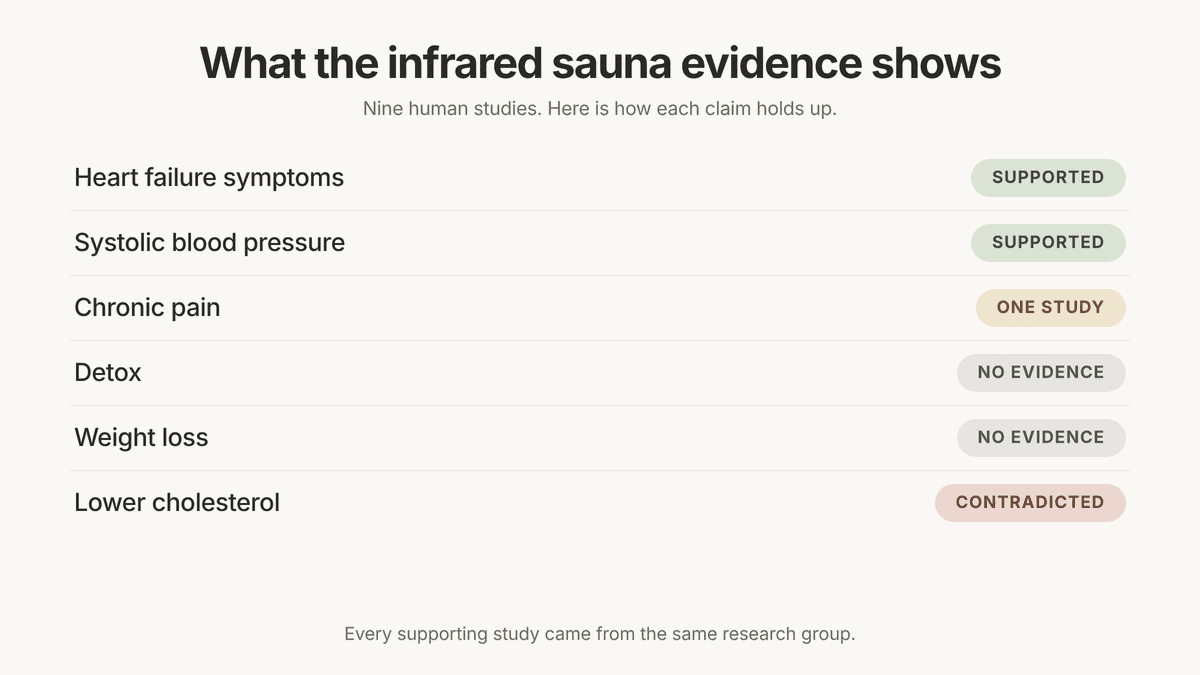
Read that last line again. On cholesterol, the published data do not merely fail to support the marketing claim — they contradict it.
What a far-infrared sauna actually is
A traditional sauna heats the air to roughly 85°C with a stove or high-voltage heater, and that hot air heats you, mostly by convection. Many people find it uncomfortable.
A far-infrared cabinet works differently. It runs at about 60°C and uses infrared elements emitting at a wavelength near 10 micrometres — the same principle as the infrared warmers used on neonatal resuscitation beds. Because infrared penetrates more deeply than warmed air, you sweat heavily at a noticeably lower temperature.
The physiological load is real but modest. Beever describes the cardiovascular demand of the thermoregulatory response — sweating, vasodilation, reduced afterload, raised heart rate and cardiac output — as similar to walking at a moderate pace. That framing is useful in both directions: it is genuine cardiovascular work, and it is not more than a brisk walk. In training terms it sits well below the sustained conversational effort of Zone 2 cardio, and nothing in this literature suggests heat exposure substitutes for it.
That comparison also points at who benefits most. Someone sedentary because of osteoarthritis, or a cardiac or respiratory condition, may get a cardiovascular stimulus from a sauna that they cannot easily get from exercise. Someone already training several times a week is adding a walk's worth of load to a much larger total.
This is worth sitting with before spending money on a cabinet. If the goal is cardiovascular fitness, the measure that actually tracks it is VO2 max, and no infrared study has ever measured it. The one trial that looked at exercise tolerance used a six-minute walking distance in hospitalised heart failure patients, where the baseline was 388 metres. That is a different population with a different ceiling.
The heart failure evidence, and it is the strongest here
Four of the nine studies concern congestive heart failure, and two are randomised.
In [one randomised trial of 30 patients] with NYHA class II or III heart failure and frequent premature ventricular contractions, ten 15-minute infrared sessions over two weeks reduced PVCs from roughly 3,097 to 848 per 24 hours compared with the untreated group. Brain natriuretic peptide fell, ejection fraction improved from 29% to 33%, and NYHA class improved in most patients.
A second randomised trial of 30 patients found clinical improvement in 17 of 20 treated patients, a drop in systolic blood pressure from 107 to 97 mm Hg, lower BNP, and improved endothelial function measured by flow-mediated dilation.
These are well-conducted for their size. The control groups sat in a similar room at 24°C for the same duration, which controls for rest and expectation about as well as sauna research allows. In the better studies, measurements were taken a full day later so that dehydration could not fake a lower blood pressure or weight.
They are also studies of hospitalised cardiac patients, run over two to four weeks, with between 2 and 46 participants. Nothing here tells you what happens to a healthy adult using a home cabinet for a year.
The limitation nobody mentions
Here is the finding that should change how you read every positive claim about infrared saunas.
Beever notes that the studies are limited by small sample sizes, short duration, unvalidated symptom scales, reliance on captive hospitalised populations — and that they were all conducted by the same core research group.
That last point matters enormously. Independent replication is how a finding stops being one team's result and becomes knowledge. A body of evidence produced entirely by one group, however carefully, has not cleared that bar. The names Kihara, Masuda, Imamura, Biro and Tei recur across nearly every study in the review.
This does not mean the findings are wrong. It means they are preliminary in a specific, important way, and seventeen years later the independent replication still has not arrived in any volume.
The detox claim
Detoxification is the most prominent benefit in infrared sauna marketing. It does not appear in Beever's evidence review at all — not as supported, not as refuted. It simply was not among the outcomes the clinical trials measured.
The physiology is not encouraging either. Sweat is over 99% water, plus small amounts of salt, lactate and antibodies. The liver carries the detoxification enzymes and the kidneys filter the blood; both routinely clear far more than the sweat glands do.
Trace heavy metals and some pollutants have been detected in sweat, which is where the claim originates. The quantities are the problem. Pascal Imbeault, a researcher at the University of Ottawa who studies persistent organic pollutants, called the amounts ["essentially meaningless"]; his team estimated that 45 minutes of high-intensity exercise — roughly two litres of sweat — would carry less than one-tenth of a nanogram of these compounds.
There is a measurement problem too. Sweat scraped from skin can contain four to ten times more lipid than cleanly collected sweat, which inflates readings for fat-soluble substances and may explain some of the striking numbers in circulation.
Actual detoxification is a medical intervention for poisoning — chelation therapy for heavy metal toxicity, for instance. It is not a sensation of wellbeing after sitting in a hot box.
The weight-loss claim
You will see infrared saunas sold for fat loss, and this is the claim where the gap between citation and reality is widest.
The single study supporting it enrolled ten obese participants. They did daily 15-minute infrared sessions for two weeks — while also following an 1,800 calorie per day diet. There was no diet-only group and no sauna-only group.
So the participants lost weight while in a calorie deficit, and the study cannot separate the deficit from the cabinet. Beever's own review raises exactly this: the paper reports a mean drop from 83.8 kg to 82.2 kg with a stated P value, but does not give the underlying means and standard deviations needed to check it.
Separately, a study of 25 men reported a statistically significant weight decrease of 0.3 kg against a standard deviation of 9.9 kg. Beever says plainly that he could not see why that would be significant, attempted to verify the P value with a statistician, and found the paper lacked sufficient data to do so.
The honest position: any immediate weight change after a sauna is water you will drink back. Nothing in this literature demonstrates fat loss from heat exposure.
Infrared versus traditional sauna
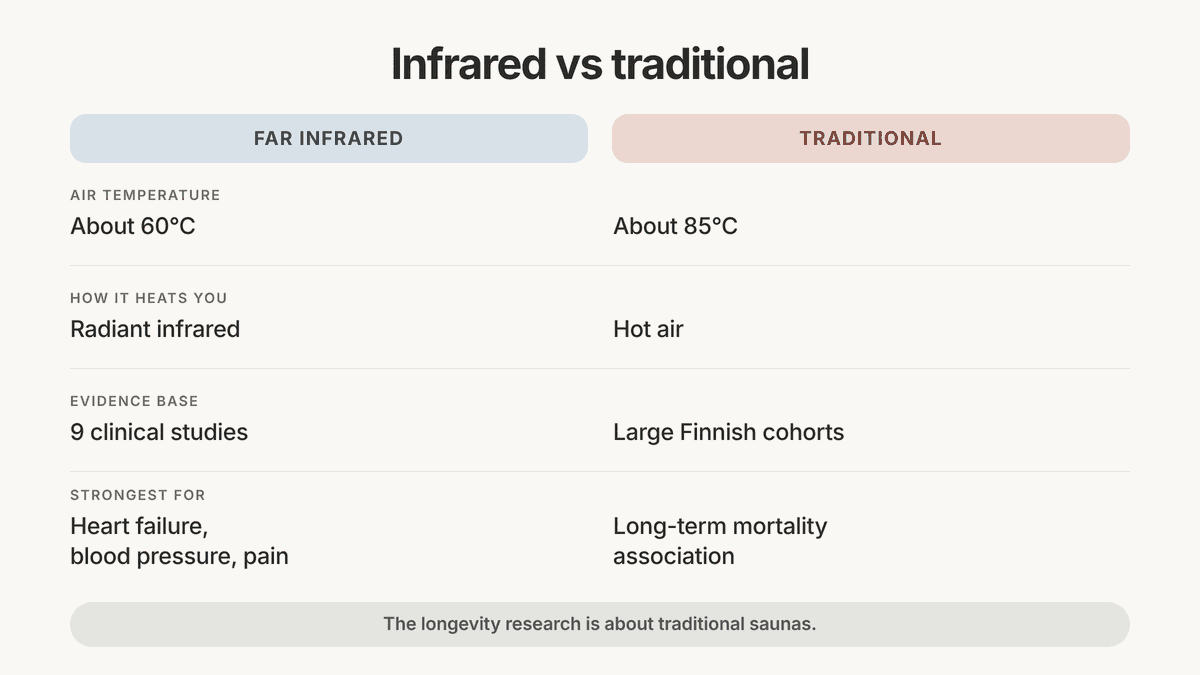
These are different interventions with different evidence bases, and it is worth being clear about which one the famous longevity findings belong to.
The large Finnish cohort data on sauna frequency and mortality come from traditional sauna bathing at around 80–90°C, not infrared cabinets. If that is what drew you to saunas, the relevant protocol — temperature, duration and frequency — is covered in the Finnish sauna frequency research, along with why infrared does not reproduce those conditions.
Infrared's case is narrower and clinical: heart failure, systolic blood pressure, chronic pain. Its practical advantage is comfort. At 60°C rather than 85°C, people who cannot tolerate a traditional sauna can often tolerate this, and a tolerable intervention performed regularly beats an optimal one avoided.
What about pain, fatigue and skin
Chronic pain has the best evidence outside cardiology. In a randomised trial of 46 chronic pain patients, the 22 who added daily 15-minute infrared sessions to multidisciplinary inpatient treatment were significantly more likely to have returned to work two years later — 77% versus 50% — with improved sleep scores and a trend toward better pain and anger scores. Promising, one study, and the follow-up period makes it unclear whether participants continued treatment.
Chronic fatigue syndrome rests on a paper with a sample size of two. That is a case report. It is not a basis for buying anything.
Skin benefits do not appear in the clinical review at all.
On safety, one genuinely reassuring note: no adverse effects were found or reported in any of the nine studies reviewed. Blood tests across several trials showed no changes in liver function, kidney function, electrolytes or haematocrit. Whatever else is uncertain here, the intervention itself appears well tolerated in supervised settings.
How to read any infrared sauna claim
A short test you can apply to any benefit you see advertised, because the pattern repeats across this entire category.
Ask which sauna the study used. A great deal of infrared marketing cites Finnish cohort research conducted in traditional saunas at 80–90°C. Those are not the same conditions and not the same evidence.
Ask how many people were in it. The infrared literature runs from 2 to 46 participants. A benefit sourced to a study of two people is a case report wearing a citation.
Ask when the measurements were taken. If weight or blood pressure was recorded straight after a session, before rehydration, both read artificially low. The better studies waited a full day and checked haematocrit to confirm participants had rehydrated.
Ask whether anyone else has replicated it. This is the one that fails most often here, and it is the question marketing copy never invites.
Who should be cautious
Talk to a clinician before starting if you have uncontrolled high blood pressure, known heart disease, are pregnant, take medication affecting blood pressure or fluid balance, or have a condition that impairs your ability to sense heat or sweat normally.
Heat exposure reduces sperm motility; traditional sauna use causes reversible decreases in sperm movement parameters, and the specific effect of infrared cabinets on sperm count has never been studied.
Keep sessions to 15 to 20 minutes and rehydrate afterwards. Every protocol in the clinical literature used 15-minute sessions — not the hour-long sittings sometimes recommended online.
✅ Key Takeaway
- Infrared saunas have real but preliminary evidence for heart failure symptoms, systolic blood pressure and chronic pain.
- Every supportive study came from one research group, with 2 to 46 participants over 2 to 4 weeks. Independent replication has not arrived.
- Detox is not supported. Sweat is over 99% water, and the pollutant quantities in it are measured in fractions of a nanogram.
- Fat loss is not supported. The one study had ten people who were also eating 1,800 calories a day.
- Cholesterol reduction is contradicted by consistent evidence, despite being a standard marketing claim.
- The Finnish longevity data belong to traditional saunas, not infrared cabinets.
Frequently Asked Questions
What are the proven benefits of an infrared sauna?
Three have clinical support: improvement in congestive heart failure symptoms, reduction in systolic blood pressure, and relief of chronic pain. All three come from small studies — between 10 and 46 participants, lasting two to four weeks — and a review in Canadian Family Physician found only nine human studies meeting level I or II evidence standards in total. The evidence is best described as preliminary rather than established.
Do infrared saunas actually detox your body?
There is no reliable evidence that they do. Detoxification does not appear as an outcome in the clinical review of infrared sauna research. Sweat is over 99% water; your liver and kidneys clear far more than your sweat glands. Trace pollutants have been detected in sweat, but one researcher who studies them estimated that two litres of sweat carries less than a tenth of a nanogram — amounts he described as essentially meaningless.
Can an infrared sauna help you lose weight?
Not in any way the evidence demonstrates. The single supporting study followed ten obese participants who were simultaneously on an 1,800 calorie per day diet, with no diet-only or sauna-only comparison group, so the calorie deficit cannot be separated from the sauna. Weight lost immediately after a session is water, and you replace it when you rehydrate.
Is an infrared sauna better than a traditional sauna?
They are different tools. The well-known Finnish research linking frequent sauna use to lower mortality studied traditional saunas at roughly 80–90°C, and infrared cabinets at around 60°C do not reproduce those conditions. Infrared's own evidence is narrower and clinical: heart failure, blood pressure and chronic pain. Its real advantage is tolerability — if 85°C is unbearable for you, 60°C you will actually use beats a protocol you avoid.
How long should you stay in an infrared sauna?
Fifteen to twenty minutes. Every protocol in the clinical literature used 15-minute sessions, typically daily or near-daily over two to four weeks. Longer sittings have no supporting evidence and increase dehydration risk. Rehydrate afterwards, and if you have a cardiovascular condition, speak to a clinician before starting.
Do infrared saunas lower cholesterol?
No, and this is the one marketing claim the evidence actively contradicts. The review of published infrared sauna research found consistent evidence refuting a cholesterol-lowering effect — studies have repeatedly measured total cholesterol, HDL and triglycerides before and after courses of sauna therapy and found no significant change.
References
Rate this article
Click on a star to rate this article
Keep Reading
Sauna Frequency: 4–7 Sessions a Week Linked to 40% Lower Mortality
Sauna protocol: The Finnish sauna study (KIHD): 4-7 sessions per week cut all-cause mortality 40%. Exact protocol, why infrared doesn't replicate it, real
Read article →
holistic wellnessCold Water Immersion Protocol: Time and Temperature
The cold water immersion protocol the research actually supports: around 11 minutes per week at 50-59 F. Time, temperature, timing, and contraindications,
Read article →
holistic wellnessBox Breathing: What the Research Actually Shows
Box breathing for stress: what a Stanford trial and a 12-trial meta-analysis found, why cyclic sighing did slightly better, and how to try it safely.
Read article →

Vitality & Strength Editorial Team
Independent research synthesists — not licensed clinicians
Independent health writers and research synthesists. We are not doctors or registered dietitians; every claim we publish is sourced and linked to primary research, and we take no affiliate or industry money.