Rhodiola for Stress and Fatigue: What the Research Shows
Rhodiola for stress and fatigue: one small trial, a few reviews and where the evidence is thin, plus safety notes.

Rhodiola is one of the most common herbal products sold for stress and tiredness, usually as a root extract standardised to rosavins and salidroside. The marketing promises a lot. The research is more modest: there is a handful of small human trials, several reviews written by people who study the plant, and very few large, long, placebo-controlled studies. This guide explains what the evidence shows for stress, fatigue and exercise, and where the gaps are.
⚕️ Medical Disclaimer
This article is general information, not medical advice. Rhodiola is a herbal product whose quality varies between brands, and it can interact with medicines, including antidepressants and drugs that affect blood pressure or blood sugar. Speak to a doctor or pharmacist before starting it, especially if you are pregnant, breastfeeding, or taking prescription medicines. If fatigue, low mood or stress are persistent or severe, get them assessed.
The short version
- The strongest single human trial is a 2015 study in Phytotherapy Research. It randomised 80 mildly anxious adults to a Rhodiola rosea extract taken as two 200 mg doses a day, or to no treatment, for 14 days. The Rhodiola group reported significantly lower anxiety, stress, anger, confusion and depression scores, with no difference in cognitive tests. It was not placebo-controlled, so the authors said they could not establish cause and effect.
- Reviews of Rhodiola describe benefits for stress-related fatigue and burnout, mostly from trials of one standardised extract, SHR-5. Some of these reviews come from researchers or companies with a commercial interest in the plant, which is worth keeping in mind.
- For exercise, a 2024 review in the British Journal of Nutrition found that a single dose of about 200 mg taken an hour before exercise may extend time to exhaustion or improve time-trial performance in recreationally active people. The benefit from taking it every day over weeks was less clear.
- Overall, the evidence is promising but thin. It is not strong enough to say that Rhodiola reliably treats stress, fatigue or depression.
What the 2015 trial actually tested
The Cropley trial used a Rhodiola rosea product in two 200 mg doses a day, one before breakfast and one before lunch. Participants were tested at four sessions over 14 days, completing mood questionnaires and cognitive tests. The group taking Rhodiola improved on most mood measures compared with controls, while cognitive performance did not differ. The trial was small, lasted two weeks, and had no placebo arm, so expectation effects cannot be ruled out. Its authors called for further trials.
This is the kind of study that makes a supplement look better than it may be. Small open trials often show improvements, and larger placebo-controlled studies are what settle the question.
Stress and burnout: what the reviews say
A 2010 review in Phytomedicine by Panossian, Wikman and Sarris summarised the Rhodiola literature and concluded that repeated doses of the SHR-5 extract reduce burnout in people with fatigue syndrome and increase the ability to concentrate in healthy subjects. The authors also described encouraging results for mild to moderate depression and generalised anxiety. A 2022 review in Molecules by Ivanova Stojcheva and Quintela reached a similarly positive view of standardised preparations for life stress and stress-related fatigue. Both are reviews rather than new trials, and the 2022 review was written by authors from a company that makes Rhodiola preparations.
The reviews also show a mechanism people often mention: Rhodiola extracts have been reported to affect the stress hormone system, including cortisol, in animal and laboratory work. Lab evidence is not the same as proof that the supplement helps people feel less stressed.
Exercise and physical performance
Rhodiola is also sold for athletes. A 2024 review in the British Journal of Nutrition covered at least sixteen human studies. The authors found that a single dose of about 200 mg, containing roughly 1 percent salidroside and 3 percent rosavins and taken 60 minutes before exercise, may prolong time to exhaustion and improve time-trial performance in recreationally active men and women. Chronic benefits were less clearly documented. Some trials with higher daily doses, about 1,500 to 2,400 mg for four to thirty days, reported gains in sprint and resistance training performance, but the trials were small and the results were mixed.
Performance effects in trained athletes are not well established, and a useful training benefit from a supplement should not be assumed from a short study.
What the evidence does not show
- It does not show that Rhodiola cures depression, anxiety disorders or chronic fatigue syndrome.
- It does not show how much to take over months or years, or whether benefits last after stopping.
- It does not show that products sold online contain the amount on the label. Quality and standardisation vary.
- It does not show safety in pregnancy, breastfeeding, bipolar disorder or with medicines that act on the brain or blood pressure. The reviews describe few serious side effects in trials, but trial populations were small and selected.
Who might consider it, and who should be careful
Someone who is feeling mentally worn down but has had a medical check, and who wants to try a standardised product for a few weeks, may reasonably discuss it with a clinician. Tiredness that is new, severe or unexplained needs medical assessment first, because thyroid problems, anaemia, low iron, sleep apnoea, depression and medicine side effects are all common causes. People taking antidepressants, blood thinners, diabetes or blood pressure medicines should check for interactions before taking it.
Keep a simple log if you try it: the product name and dose, the start date, and a few weekly ratings of sleep, mood and energy. Stop and seek advice if you notice palpitations, agitation, insomnia or stomach upset.

Practical takeaways
- Treat the evidence as promising but limited. The best human trial is small and not placebo-controlled.
- Most reviews are positive, but several are by people with ties to the supplement industry.
- For performance, the strongest signal is a single dose about an hour before exercise, not a long course.
- Speak to a clinician before using it with medicines or in pregnancy, and do not use it to replace assessment of fatigue or low mood.
- Stress, sleep and workload usually need attention first; a supplement can be at most a small addition to that.
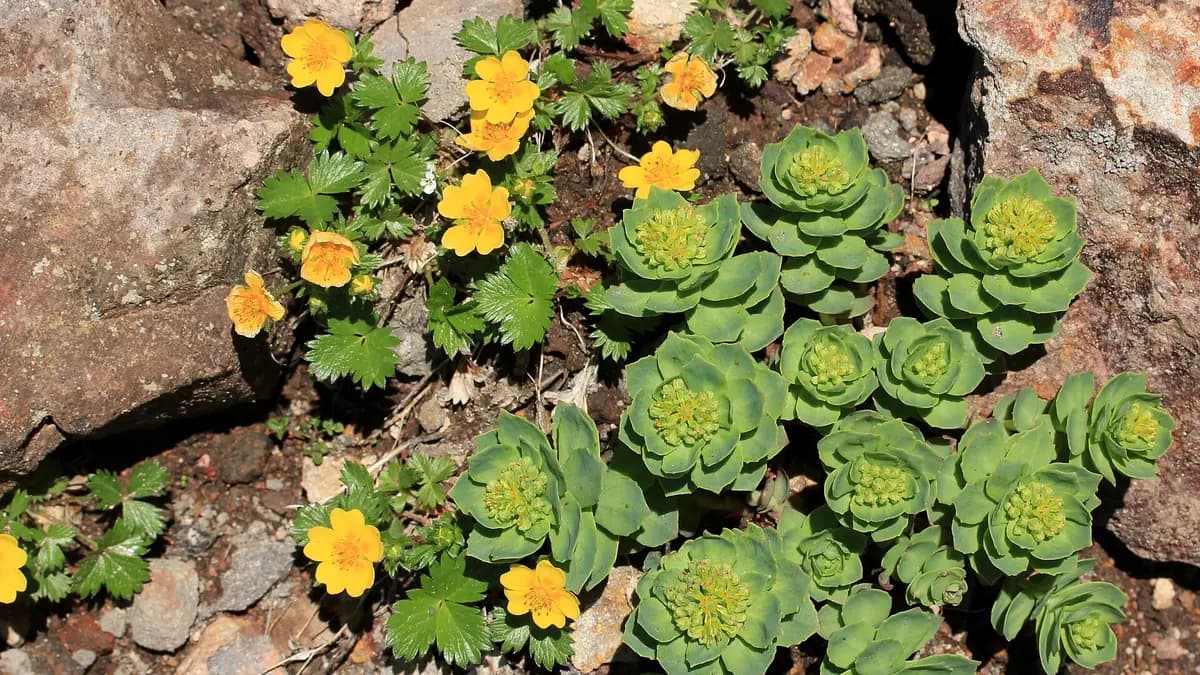
Photos: Rhodiola rosea plant (Wikimedia Commons, CC BY-SA 4.0). Second photo: Rhodiola rosea and Potentilla matsumurae (Wikimedia Commons, CC BY-SA 4.0). Both are cropped and colour-adjusted.
Frequently asked questions
Frequently Asked Questions
Does Rhodiola reduce stress?
One small 2015 trial found lower self-reported stress, anxiety and low mood after two weeks in people taking two 200 mg doses a day, compared with a no-treatment group. The trial was not placebo-controlled, and the authors said cause and effect could not be established. Reviews are more positive, but several are by people with ties to the supplement industry.
Is Rhodiola good for fatigue?
Reviews describe benefits for stress-related fatigue and burnout, mostly with a standardised extract. The human evidence is limited and the trials are small. Persistent tiredness should be assessed by a doctor, because iron deficiency, thyroid problems, sleep disorders and low mood are common causes.
When is the best time to take Rhodiola for exercise?
A 2024 review found that a single dose of about 200 mg taken around 60 minutes before exercise may improve time to exhaustion or time-trial performance in recreationally active people. Long-term benefits for performance were less clear.
Are there side effects or interactions?
Trials have reported few serious side effects, but they were small. Rhodiola may interact with antidepressants, blood pressure medicines, blood thinners and diabetes medicines, and its safety in pregnancy and breastfeeding is not established. Check with a pharmacist or doctor first.
Should I take Rhodiola instead of seeing a doctor?
No. Stress, low mood and tiredness can have medical causes, and a supplement is not a substitute for assessment. If symptoms are severe, persistent or affecting daily life, see a doctor or mental health professional.
References
[Cropley M, Banks AP, Boyle J, "The Effects of Rhodiola rosea L. Extract on Anxiety, Stress, Cognition and Other Mood Symptoms," Phytotherapy Research, 2015. PMID 26502953] [Panossian A, Wikman G, Sarris J, "Rosenroot (Rhodiola rosea): traditional use, chemical composition, pharmacology and clinical efficacy," Phytomedicine, 2010. PMID 20378318] [Ivanova Stojcheva E, Quintela JC, "The Effectiveness of Rhodiola rosea L. Preparations in Alleviating Various Aspects of Life-Stress Symptoms and Stress-Induced Conditions," Molecules, 2022. PMID 35745023] [Tinsley GM et al., "Rhodiola rosea as an adaptogen to enhance exercise performance: a review of the literature," British Journal of Nutrition, 2024. PMID 37641937]Rate this article
Click on a star to rate this article
Keep Reading
Iron and Fatigue: What the Research Shows
Iron and fatigue: what the 2025 review and a Cochrane review found, how big the effect was, and why testing first matters.
Read article →
mental healthOmega-3 and Depression: What the Research Shows
Omega-3 and depression: what a 2025 meta-analysis found, how small the effect was, and why it is not a replacement for treatment.
Read article →
mental healthSaffron and Mood: What the Research Shows
Saffron and mood: what 2026 and 2019 meta-analyses found, how large the drop in self-reported symptoms was, and why clinician scales need care.
Read article →

Vitality & Strength Editorial Team
Independent research synthesists — not licensed clinicians
Independent health writers and research synthesists. We are not doctors or registered dietitians; every claim we publish is sourced and linked to primary research, and we take no affiliate or industry money.